



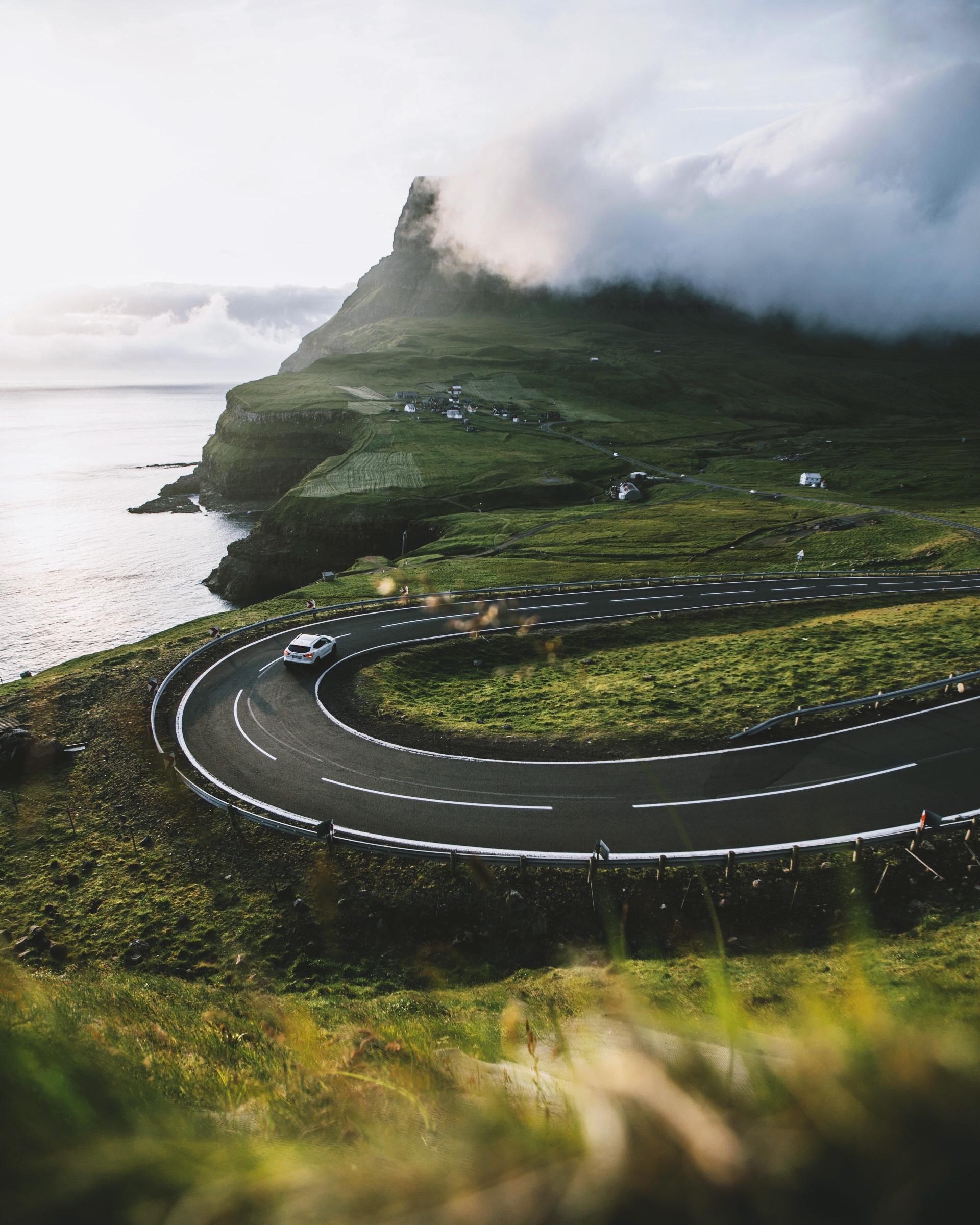
Driving in
the Faroe Islands
Driving in
the Faroe Islands
Renting a car is a very popular way to get around. It's easy and gives you the possibility to decide your own route.
Most of the islands are connected via bridges and subsea tunnels, making it effortless to drive around.

 easy and flexible
Getting Around the Faroe Islands Is Remarkably Easy Thanks to Its Modern, Connected Infrastructure

Effortless travel with roads, bridges, and subsea tunnels.
Seamless island travel with modern infrastructure.
All tunnel tolls are covered from your deposit.
See Múlafossur, Gjógv, and Kalsoy Lighthouse in one day.
Explore all day and still return to Tórshavn for dinner.
Driving Essentials

A valid driver’s license from your home country is accepted. International driving permits are not required but recommended for non-Latin alphabet licenses.

In the Faroe Islands, you drive on the right-hand side of the road, same as in continental Europe and the United States.

Speed limits are 50 km/h in towns, 80 km/h on open roads. Tunnels have specific limits posted at entrances. Always follow posted signs.

It is never permitted to drive off-road in the Faroe Islands.
This is to conserve the landscape and to ensure the safety of drivers. Fines are issued for driving off-road.

Headlights must be on at all times while driving, even during daylight hours. This is a legal requirement in the Faroe Islands.
Driving Tips & Info
Road Conditions

All major highways are paved, but some roads - especially to smaller villages - are gravel.
Loose gravel can make driving difficult; drive carefully.
Many village roads and tunnels are narrow; adjust speed to road conditions.
Lay-bys are provided to allow cars to pass and must not be used for parking.
Speed Limits
Urban areas: 50 km/h
Rural areas (asphalt & gravel roads): 80 km/h
Navigation & Maps
Road maps are recommended, or use GPS navigation.
Free maps are available at the rental desk upon arrival.
Safety & Legal Requirements
Headlights must be used at all times, day and night.
Seat belts are mandatory for all passengers (front and back seats).
Mobile phone use while driving is prohibited.
Driving under the influence of alcohol is strictly forbidden.
Local Driving Tip
If a car behind you flashes its headlights twice, it is politely asking to overtake.
Locals are accustomed to narrow, winding roads and tend to drive faster - pulling over is appreciated.